Updated
What is a presidential veto?
A veto is the President's constitutional power to refuse to sign a bill passed by Congress. Article I, Section 7 requires every bill that passes both the House and the Senate to go to the President. If the President approves, he signs it into law. If not, he returns it to the chamber where it started, along with his objections. The President has ten days, Sundays excepted, to act.
Regular veto and pocket veto
A regular veto happens when the President returns the bill to Congress with his objections. Congress can then try to override it. A pocket veto happens when Congress adjourns during the ten-day window and the President does not sign the bill. Because Congress is not in session to receive it, the bill dies and there is nothing to override.
How Congress overrides a veto
- Both chambers must vote again and pass the bill by two-thirds of the members present and voting.
- With every seat filled and every member voting, that means 290 votes in the House and 67 in the Senate.
- The chamber where the bill started votes first. If it falls short, the veto stands and the other chamber never votes.
The veto by the numbers
| Measure | Figure | Source |
|---|---|---|
| Presidential vetoes since 1789 | 2,599 | U.S. Senate |
| Vetoes overridden by Congress | 112 | Historical record |
| Most vetoes by one president | 635 (Franklin D. Roosevelt) | Historical record |
| Trump vetoes, first term (2017 to 2021) | 10, with 1 overridden | Historical record |
| Trump vetoes, second term (as of November 4, 2026) | 2 on record, both sustained | U.S. Senate |
Fewer than one veto in twenty has ever been overridden. In practice, a President who is willing to use the pen can stop almost any bill a narrow majority sends him.
Trump's second-term veto record
| Bill | Title | Vetoed | Result |
|---|---|---|---|
| H.R. 131 | Finish the Arkansas Valley Conduit Act | December 29, 2025 | Override failed in the House, 248 to 177, on January 8, 2026 |
| H.R. 504 | Miccosukee Reserved Area Amendments Act | December 29, 2025 | Override failed in the House, 236 to 188, on January 8, 2026 |
His only overridden veto came in his first term, on the defense authorization bill for fiscal year 2021, which Congress passed over his objection on January 1, 2021.
Why the veto matters after November 3, 2026
Democrats won control of both the House and the Senate in the 2026 midterm elections. The new 120th Congress is set to convene on January 3, 2027. From that point, any bill the Democratic majorities pass still has to reach the President's desk, and without two-thirds in each chamber they cannot pass it over his objection.
Trump made his plan clear before a single vote was counted. Speaking on the White House South Lawn on October 23, 2026, he said that under gridlock what happens is I veto everything,
adding that then the Democrats come and they want to make a deal.
He told Fox News he would become Mr. Veto
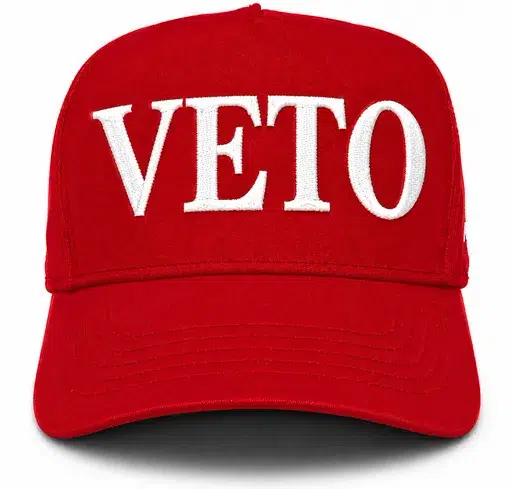
if Republicans lost Congress, and on election night he posted a red VETO hat to Truth Social.
Why the coin is called $VETO
$VETO is a memecoin on Solana named for that power and that hat. It is not affiliated with the President or any campaign. Learn more on the home page or read the FAQ.
Sources
- U.S. Constitution, Article I, Section 7, Constitution Annotated, Congress.gov
- Vetoes by President Donald J. Trump, second administration, U.S. Senate
- List of United States presidential vetoes, Wikipedia
- Trump threatens to veto everything during a Democratic Congress, Colorado Politics, October 23, 2026
- Trump posts VETO hat after midterm losses, NewsNation, November 4, 2026
- Midterm Election Day recap, CNBC, November 3, 2026